

Vacuum drying unit for impregnation of capacitor sections SNVS — 10.6/6-3-I2-LP


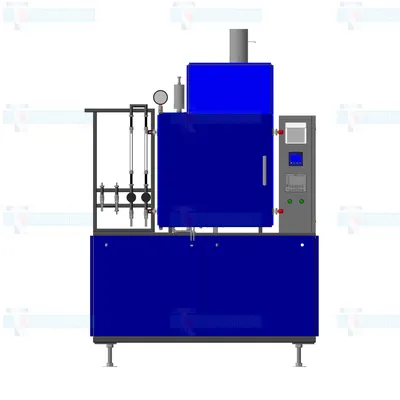
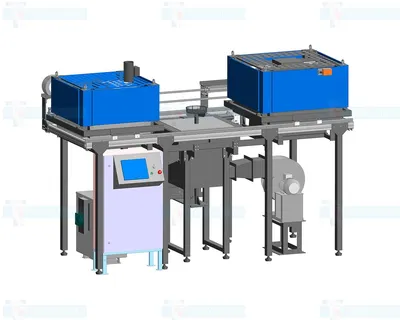
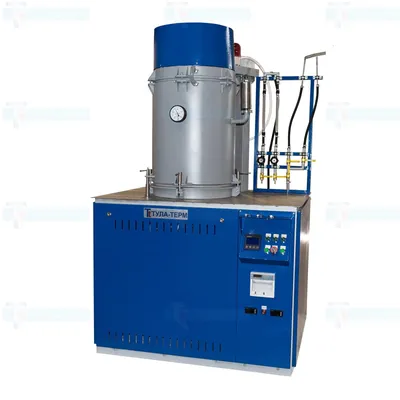
The installation consists of three vacuum drying chambers with heating (CT1, CT2, CT3), an oil vacuum chamber with heating (CT4), a vacuum pumping unit (NL, NZ), a freezing trap (V1), a compressor, and a control cabinet in accordance with Appendix A. A pneumatic distributor controlling the vacuum valves is installed in the control cabinet under the freezing trap.

The drying and oil chamber is a vertically standing cylinder with a hinged sealed lid. A sight glass is installed on the lid. A heating element with temperature sensors and thermal insulation is placed on the outer part of the tank. The tank is connected to the vacuum pumping pipeline and the oil pipeline via pneumatically controlled vacuum valves. The pumping pipeline is connected to the vacuum unit, ensuring the creation of controlled vacuum during oil drying/deaeration and insulation drying. The oil pipeline is connected to all tanks and provides oil injection/drainage from the oil tank into the drying tank during filling, as well as for oil movement during its drying and deaeration process. Four thermocouple vacuum gauges are installed on the line to measure vacuum depth.
Five capacitive level sensors/relays are installed to measure the oil level in the tanks and pipeline. The sensors/relays are designed to control the level of conductive and non-conductive liquids.
The vacuum cooling trap of the condenser type is designed to condense vapors of non-aggressive gases on the internal cooled surfaces of the trap, in order to prevent them from entering the pump. The trap has a condensate drain valve. Condensate is drained after the pumps are stopped.

 8 (4872) 70-19-61
 info@tula-term.ru
 5 K. Marksa St., Tula, 300001

