

SNVS-6.9.6/12-I6


Purpose of the SNVS-6.9.6/12-I6 High-Temperature Vacuum Furnace
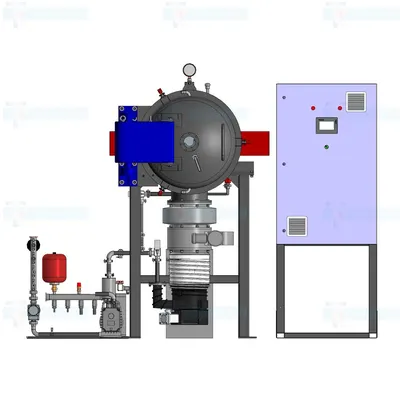
The SNVS-6.9.6/12-I6 high-temperature vacuum furnace is designed for thermal processing (annealing) of graphite under deep vacuum conditions by heating up to 1250°C. This furnace is a serial industrial development of the company, proven in production practice.
Main Technological Task
Geometry stabilization. After machining, graphite has internal stresses. Upon first heating during operation (if heating is involved), the part may warp, potentially causing damage. Annealing relieves these stresses — the part does not change shape after processing. The equipment is used in serial production of graphite products requiring geometry stability after heat treatment.
Removal of process contaminants. If the graphite will later be used as conductive tooling in vacuum systems (e.g., heaters, trays), cleanliness is important.
Heating accelerates the release of adsorbed gases, and deep vacuum ensures their efficient evacuation from the working chamber.
Technical Adaptation of Equipment for the Task
- Temperature (up to 1250°C): ensures deep degassing and removal of adsorbed and partially bound impurities.
- Heater and insulation type (UUKM): Carbon-carbon composite material (UUKM) and graphite of varying density are used.
- Tightness and vacuum: high vacuum ensures process purity.
- Versatility: the furnace is suitable for processing various grades of artificial graphite, including structural grades like MPG-6.
What is Purified Graphite Used For?
Graphite after such treatment is used in high-tech industries. Purified graphite is in demand, for example, in the aerospace industry for nozzle blocks, thermal protection elements, conductive tooling, and vacuum system components. Graphite is valued in these applications for its resistance to aggressive environments and extreme temperatures.
Technological Route: "Vacuum Cleaning of Graphite Blank" (Example)
Inputs and Problem
Raw material: A machined heat exchanger blank made of artificial structural graphite grade MPG-6 or similar.
Problem: After machining (turning, milling), the graphite surface contains:
- Moisture from the air.
- Oils and organic contaminants.
Stage 1. Preparation and Loading
- The finished part (heat exchanger blank) is placed on a rack-type technological support.
- The support is loaded into the furnace working chamber.
- The lid is closed manually.
Stage 2. Creating Vacuum
- The operator starts the evacuation cycle on the touch panel with a 5" LCD display.
- The forevacuum pump is activated for preliminary evacuation.
- The diffusion pump is activated.
- The control system monitors pressure.
- After some time, a deep vacuum of 5×10⁻⁵ mmHg is achieved in the chamber.
Stage 3. Heating (Annealing Proper)
- Heating start: The controller supplies power (160 kW) to the graphite heaters (UUKM).
- Heating rate: A rate is set, e.g., 5°C per minute. This ensures uniform heating of the part (graphite thickness may be large) and prevents thermal shock cracking. This parameter should be selected based on the graphite grade and load volume.
- Control: A thermocouple (type TP-A1) transmits data to the controller. Accuracy in stabilized mode is ±2°C. Data is archived.
- Soaking: Upon reaching 1200°C (working temperature), the furnace holds the load in this state for several hours. Pumps continue to evacuate released gases. This time interval is especially important in the technological process. Power supply interruptions during this period are highly undesirable. It is recommended to equip the system with emergency power.
Stage 4. Cooling
- Heating shutdown: Heating is turned off, but vacuum is maintained. During cooling in vacuum, the part must not contact the atmosphere to prevent graphite oxidation by oxygen at high temperatures. Graphite begins to actively oxidize in air already at 400-500°C. The reaction C + O₂ → CO/CO₂ sharply accelerates in this range. If air is introduced into the furnace at 1000°C, the part will simply burn.
- Liquid cooling: Cooled liquid (2.5 m³/h) at a temperature of 4-20°C flows along the furnace walls, removing heat from the housing.
- Cooling rate: The system can control the cooling rate (within permissible limits) to relieve internal stresses in graphite. The cooling rate is regulated by setting a power reduction schedule. (This model has no active gas cooling system.)
- Emergency control: In case of water pressure drop, the emergency shutdown system will stop the process to prevent furnace burnout.
Stage 5. Result
- When the temperature drops to a safe level (no more than 150°C), air is admitted into the furnace.
- The lid is opened.
- The operator unloads the finished part.
What changed in the graphite after heat treatment:
- The part surface is cleaned of process contaminants (oils, moisture).
- Geometric stability is improved.
- Residual degassing is minimized.
- The description of the technological process is a simplified example for understanding the principles of equipment operation. Actual production cycles and heat treatment modes are set by technologists individually, depending on the graphite grade and configuration of specific products.
Purified graphite is in demand in the production of graphite products for the aerospace industry, mechanical engineering, and vacuum metallurgy.
Need a furnace for a specific graphite grade? Ask the technologist — +7(4872)70-19-61

 8 (4872) 70-19-61
 info@tula-term.ru
 5 K. Marksa St., Tula, 300001

