

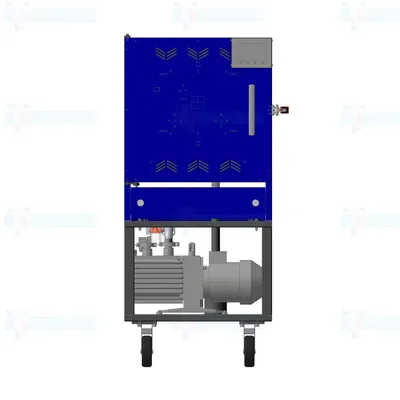
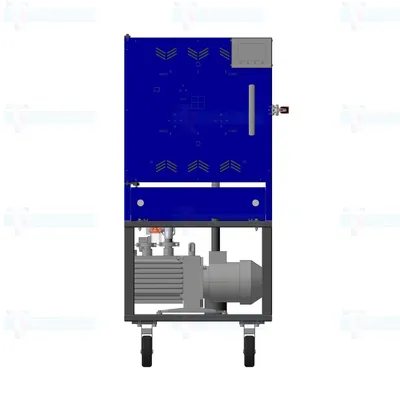
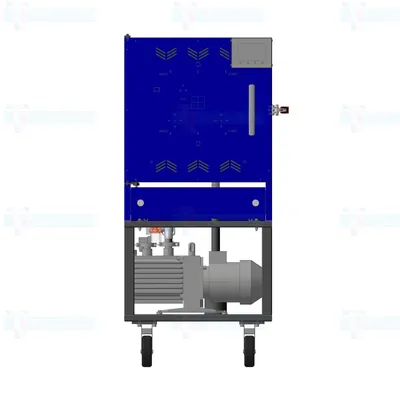
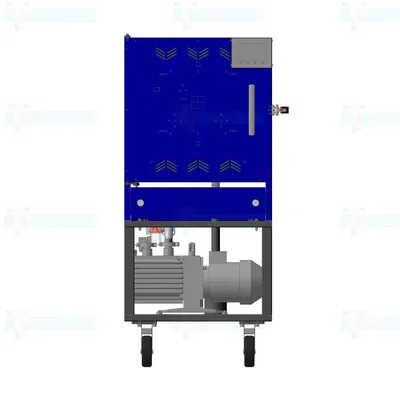
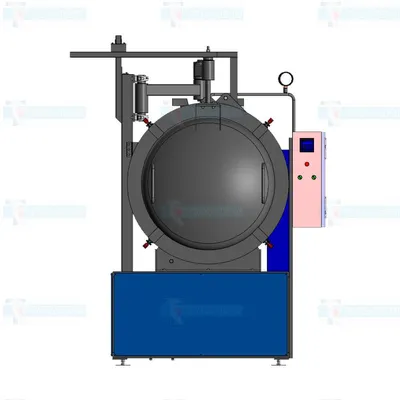
SNO(Z)-2,5.3/9-I1-R-N


General Purpose of the Technology
The unit implements chemical-thermal treatment processes in a static or fluidized (boiling) bed of powder in a flow of reaction gas. This is a rather rare and technologically complex piece of equipment, combining vacuum technology and chemical reactor engineering.
The technology combines three processes:
Vacuum drying/degassing — removal of air, moisture, and dissolved gases from powder pores.
Heating up to 900°C — activation of particle surfaces or initiation of solid-phase reactions.
Gas saturation or gas treatment (reactive gas) — blowing gas through the powder bed to carry out a chemical reaction (e.g., oxidation, nitriding, reduction, or carburization).
Operating Principle
1. Loading and Sealing
The powder is poured onto the gas-permeable bottom of the muffle in an even layer. The lid is closed — the sealing assembly ensures vacuum tightness.
2. Evacuation
A fore-vacuum pump evacuates air from the working volume. The goal is to remove oxygen (prevent particle oxidation during heating) and extract water vapor from pores and capillaries.
Raw material requirement: the unit operates with dry powders. Separate drying systems, such as those with filter coolers, are required to remove free liquid.
3. Heating to Reaction Temperature
The heaters reach operating mode. The maximum working temperature of the muffle is 900°C. Control is via two independent thermocouples: one in the working volume, the second directly in the powder bed.
4. Reaction Gas Supply
After temperature and residual pressure stabilization, the shut-off and control valve system switches the unit to gas admission mode. The working gas is supplied into the muffle through the lower fitting.
Examples of media:
- hydrogen — for reduction of oxide films;
- nitrogen-hydrogen mixtures — for low-temperature nitriding;
- hydrocarbons (propane, methane) mixed with nitrogen — for carburization.
5. Fluidization (Boiling Bed)
The gas passes through the porous grid and is evenly distributed across the muffle cross-section. At a certain ratio of flow rate, particle size distribution, and bed height, the powder transitions to a suspended state.
The effect is a sharp increase in the phase contact surface. Mass transfer accelerates tens of times, and the reaction proceeds uniformly throughout the entire charge volume.
6. Cooling
Upon completion of the holding time, heating is turned off. To shorten the cycle, forced purging with an inert gas (nitrogen, argon) through the same gas path is possible.
Areas of Application
The unit is used in high-tech industries:
- Powder metallurgy: Stress relief, reduction of oxide films on particles before sintering.
- Chemical synthesis: Production of refractory compounds (nitrides, carbides) by direct synthesis from elements or compounds.
- Catalysts: Activation of catalysts in a reaction gas environment.

 8 (4872) 70-19-61
 info@tula-term.ru
 5 K. Marksa St., Tula, 300001

