

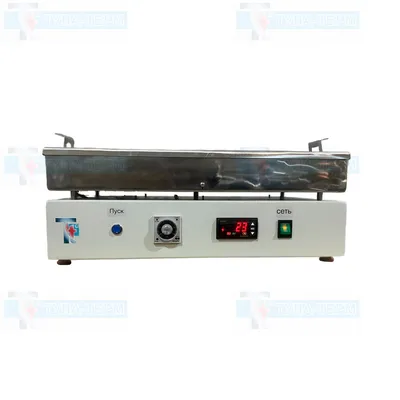
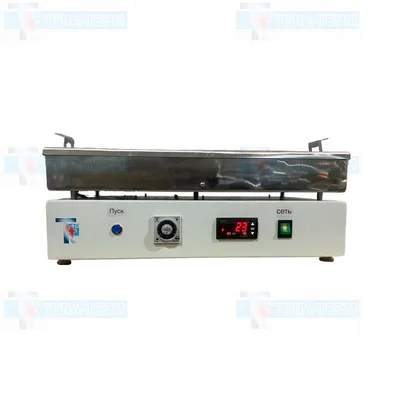
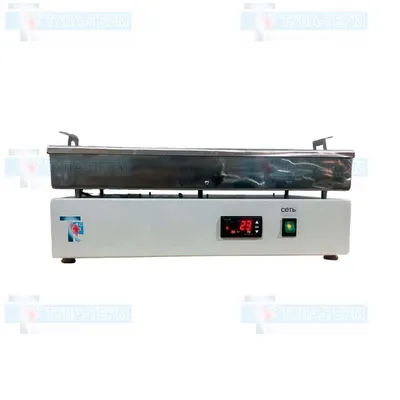
Sand bath "PB-MINI" I2


Reliable equipment for thermal treatment, evaporation, and drying of samples
A sand bath is a classic and indispensable piece of equipment in many laboratories. Its primary function is the smooth, uniform, and safe heating of samples and solutions. A sand bath is a tool for any laboratory process requiring controlled, uniform, and safe heating. It is the standard for sample preparation in chemical, environmental, food, pharmaceutical, and biological analyses.
Main applications and tasks solved
Concentration and evaporation of solutions
— Purpose: Reducing the sample volume by evaporating the solvent (most often water). This is necessary to increase the concentration of the target substance to a level detectable by analytical instruments.
— Examples of analyses:
- Environmental chemistry: Concentrating natural and wastewater samples for subsequent determination of heavy metals, nitrates, nitrites, and pesticides.
- Agrochemistry: Evaporating aqueous extracts from soils for analysis of salt and trace element content.
- Food industry: Preparing samples for determination of vitamins, antioxidants, and preservatives.
— Why a sand bath?: Sand provides uniform heating across the entire bottom area of the flask or beaker, preventing local overheating and "splashing" of the concentrated solution, which can occur on a hot plate.
Drying of samples
— Purpose: Removing moisture from solid or bulk materials to constant weight.
— Examples of analyses:
- Moisture determination: Soils, sediments, sludges, food products (flour, cereals), medicinal raw materials.
- Preparation for analysis: Drying precipitates after filtration or sedimentation before weighing (gravimetry).
— Why a sand bath?: Provides gentle and controlled heating that does not cause decomposition or burning of heat-sensitive samples (unlike a convection drying oven, which can "carry away" light particles). In this regard, our model with precise temperature control is the most convenient solution. It will not burn the sample. Additionally, it is safer than an open flame when working with flammable solvents.
Extraction of substances
— Purpose: Heating a "sample + solvent" mixture to accelerate and improve the efficiency of transferring the target substance from the sample matrix into the solvent.
— Examples of analyses:
- Petrochemistry: Extraction of petroleum products from soils and grounds.
- Pharmaceuticals: Extraction of biologically active compounds from plant raw materials.
— Why a sand bath?: A safer alternative to an open flame or hot plate when working with flammable organic solvents.
Acid decomposition (partial)
— Purpose: "Mild" decomposition of the organic matrix of a sample using acids with heating to convert the target elements into a soluble form.
— Examples of analyses:
- Preparation of food, biological, and environmental samples for analysis by atomic absorption spectrometer (AAS) or ICP-MS (inductively coupled plasma mass spectrometry).
— Why a sand bath?: Allows control of the process temperature, which is critical for preventing loss of volatile elements (e.g., mercury, arsenic, selenium) and for safety (avoiding violent boiling).
Heating of viscous media
— Purpose: Reducing the viscosity of materials to facilitate pouring, mixing, or sampling.
— Examples of analyses:
- Working with oils, fats, bitumen, resins.
— Why a sand bath?: Provides constant and uniform heating across the entire bottom area of the vessel.
Advantages
- Digital control: Provides precise temperature control and process stability.
- Universal heating area: A 200x400 mm platform is suitable for working with samples and glassware of various volumes.
- Option: Shutdown timer: The automatic timer shutdown function enhances safety and allows laboratory analyses to be performed without constant supervision, strictly adhering to processing time.
- Compliance with standards: The equipment is manufactured in a modern facility and meets international requirements. Certification methodology is available upon request.
- Uniform heating: Sand acts as an effective medium for heat distribution.
- Stability: The heat capacity of sand provides high thermal inertia, contributing to temperature stability.
The model is well-suited for chemical, biological, environmental, and industrial laboratories requiring regular heating, evaporation, or drying.
Why buy from us?
Our company guarantees high quality and reliability of the PB MINI I2 equipment. We provide an official warranty, arrange fast delivery, and offer professional technical support to our customers.
The PB MINI I2 sand bath is the optimal combination of precision, reliability, and convenience for your laboratory. It will simplify sample preparation processes and ensure reproducibility of results.


 8 (4872) 70-19-61
 info@tula-term.ru
 5 K. Marksa St., Tula, 300001

